
Prospective students
International
Applicants
Studying in another country is a big step—one that can shape your future.
Find out why so many students choose Collège Boréal. Browse this page, explore our website, and start imagining your future with us.
At Boréal, you’ll be welcomed and feel right at home!
About Collège Boréal
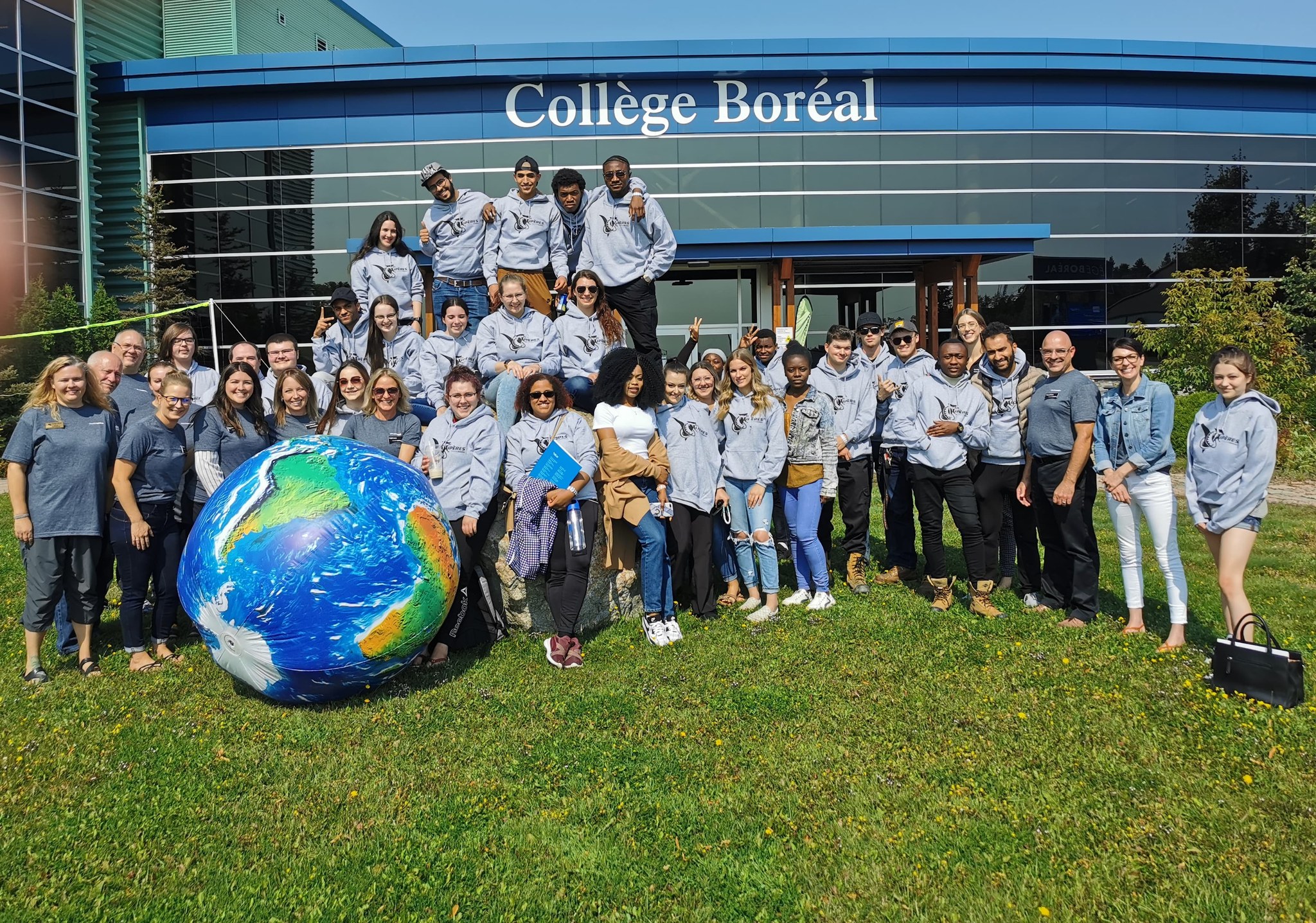
Collège Boréal is a French-language college that brings together a diverse community and prepares a highly skilled bilingual workforce (French and English). Our graduates make a difference in their communities and contribute to Canada’s economic, social, and cultural vitality.
Boréal stands out for:
- A personalized approach
- Modern labs and equipment
- Internships and placements with well-known international companies
- Comprehensive student support services
- A vibrant campus life
Federal Pilot Program for International Students
Collège Boréal is proud participate in the Francophone Minority Communities Student Pilot (FMCSP) program.
This program may allow you to transition directly from temporary resident status to permanent residency once you complete your studies.
You’ll also benefit from settlement services before, during, and after your studies to help you adjust to your new community.

Good to know
Requirements
Language requirements – French
All of Collège Boréal’s post-secondary programs are offered in French and require a very good level of French. If you have completed all of your high school studies (bachelor’s degree) or if you have completed post-secondary studies (bachelor’s degree, master’s degree or doctorate) in a recognized French-language institution, you will not be required to submit the results of a French test for admission purposes.
If your previous education was in a non-French system, you must demonstrate that you have the language skills required for admission. Click here for the French tests officially recognized by Collège Boréal and the results required for admission.
Why do some programs require a strong level of English?
Several programs at Collège Boréal require a good command of English for the following reasons:
- Some course materials are only available in English.
- Work placements often take place in bilingual environments.
- You need to be able to communicate comfortably in English, both orally and in writing.
Please note: English as a Second Language (ESL) courses offered in francophone schools are not accepted for admission purposes.
Visit English equivalency chart for the list of English placement tests recognized by Collège Boréal and the minimum scores required for admission.
Specific requirements for the programs of study
The candidate must meet the admission requirements of his or her program of study. Carefully read the prerequisites in the program descriptions.




Application for a Study Permit (Visa)
International students who plan to study in Canada must obtain a study permit. It is strongly recommended that you begin your immigration procedures as soon as you receive your letter of offer of admission to Collège Boréal.
The information below may change without notice. You are responsible for initiating all necessary steps with the Government of Canada. For detailed information, click here to consult the Immigration, Refugees and Citizenship Canada(IRCC) website.
If you decide to use the services of a representative for your application, choose this person carefully. If you hire a paid representative, make sure they are authorized. Click here for IRCC’s advice..
A Regulated Immigration Counselor for International Students (RICIS) works at the International Office of Collège Boréal. She will be able to advise you on your application for a study permit as well as all your immigration procedures related to your studies.
Steps to Follow:
- Read the general information..
- Read the instruction guide.
- Make sure you have the information required by your visa office..
- Gather all the necessary documents for your application.
- Check the processing times of your visa office so you can submit your application on time.
- Go step by step and read the information carefully.
- Finally, when you are ready, file your application online OR file your application at a Visa Application Center. Choose the method that works best for you.
- If you live in China, India, Morocco, Pakistan, Philippines, Senegal or Vietnam, you may be able to get your study permit faster by applying online in the Direct Study Stream.
Comparative Tables of Education Systems
Your filters did not return any results.
IMPORTANT NOTICE: APPLICANTS OUTSIDE CANADA
Since January 22, 2024, most international students are required to include a Provincial Attestation Letter (PAL) with their study permit application. This letter is issued by the province or territory where you plan to study.
If you applied to Collège Boréal for the 2024–2025 academic year, please check your email and your account in the OCAS International Application Service (IAS) Applicant Portal.
For details, see the PAL FAQ section below or visit the IRCC website.
FAQ – Provincial Attestation Letter (PAL)
Since January 22, 2024, most international students must provide a Provincial Attestation Letter (PAL) with their study permit application. The PAL is issued by the province or territory where you plan to study.
You do not need a PAL when applying for a study permit if you have entered Canada and one of the following situations applies to you:
- You have a study permit and are applying for a study permit extension.
- You have a work permit.
- You’re a temporary resident who is a visiting or exchange student studying at a designated learning institution (DLI).
- You’re a temporary resident who has completed a course or program of study that is a prerequisite to you enrolling at a DLI.
- You’re under a removal order but can’t be removed from Canada at this time.
- You have a temporary resident permit valid for at least 6 months.
- You’re a protected person.
Visit the Immigration, Refugees and Citizenship Canada (IRCC) website for the full list of exemptions.
Canada is trying to stabilize growth by reducing the number of study permits issued to foreign students. To stabilize growth, the federal government has implemented a national cap on study permit applications. To implement the cap, every study permit application submitted to Immigration, Refugees and Citizenship Canada (IRCC) will also require an attestation letter from a province or territory.
NO. A distribution process is now in place. If you have received an admission offer letter from Boréal, you will receive an email explaining the PAL requirements and process.
Yes. To qualify, you must:
- Receive a letter of acceptance
- Accept your offer of admission within the deadline stated in your letter
- Pay the required initial deposit
If your study permit is refused, this deposit will be refunded once you provide the official refusal letter from IRCC.
For the start of the September 2024 school year, Collège Boréal is committed to issuing approved PALs no later than June 30, 2024. This will allow you to submit your study permit application within a reasonable time frame.
Boréal will submit the names of eligible* PAL candidates to the province of Ontario. If a PAL is granted in your name, Collège Boréal will contact you by email. Please note that a PAL does not guarantee a study permit.
*Due to the limited number of PALs, Collège Boréal may give priority to certain applications. Additionally, we reserve the right to revoke an offer of admission, modify our programs, services and policies and suspend any program without notice.
PALs must be submitted by a designated educational institution (EED), such as Collège Boréal. You CANNOT apply for this yourself. If a PAL is granted in your name, Collège Boréal will contact you by email and the PAL will be uploaded to the OCAS International Admission Service (IAS) portal.
The PAL is one of several documents required by IRCC for your study permit application. When you apply for your study permit online, you will need to upload the PAL to the Personal Checklist. Please note that a PAL does not guarantee a study permit. You must submit to IRCC all the required documents.
If a PAL is not granted in your name, Boréal will contact you by email to go over your options.
Check your emails regularly as well as your OCAS International Admission Service (IAS) portal account. Carefully read all communications and documents regarding your application. To increase your chances of admission to Collège Boréal, meet the conditions and respect the deadlines specific to your application.
The PAL is issued by the province to the college, then uploaded to the IAS portal. Once your initial deposit is paid, the average processing time is about three weeks.
A PAL can only be used once, even if it remains valid. If your study permit is refused, you’ll need to request a new PAL to reapply.
For more information, see the When to get a new PAL/TAL section on the IRCC website.
Contact Information
Collège Boréal International Office


Request for Information
Please complete the form below. A team member will contact you.